I've been missing me some baseball. This summer just felt really off not even watching a game since I've been here. Sure I've caught clips of things or watched gamecast on ESPN.com or MLB.com, but that just hasn't been the same. I tried to find some streaming feeds a 0200 this morning to get the Twins VS Yankees game and none of the sites I had been using were working. I was already awake and had gone to bed at 2100 so I could get up for this, so what was I supposed to do, go back to bed? Wrong.
I caved in and bought the MLB Playoffs Package so I can watch the playoffs live from my computer. I am so glad I made that call. I'm sitting in the middle of the 5th inning watching the Twins take the lead earlier in the game against the Yankees and CC Sebathia. I've only had a few issues with the streaming so far, and I'm pumped to keep watching and finishing up my homework for class this morning.
I have to say, though, I miss this. I miss watching this game. The game's back on, so it's back to that. Man the internet is awesome. Let's go Twins!
Wednesday, October 6, 2010

You Can't Please Everybody
I'm not trying to be super negative here, but I'm starting to learn, even more so, an important lesson about being in leadership positions. You sometimes need to make a decision and often you will upset somebody. No matter how much you think about the consequences, there will be people who think you made the wrong choice.
It is easy to let these things get to you, it is very easy to feel like you're making bad decisions. I keep coming back to the idea that I should focus on those that appreciate the effort you have put forth. Sometimes this is just hard to do though, it's not easy to put aside criticism. This is especially true when the other person has a valid point. I just need to stand by how I felt and the logic behind my choices and trust that I made the right decisions.
It is easy to let these things get to you, it is very easy to feel like you're making bad decisions. I keep coming back to the idea that I should focus on those that appreciate the effort you have put forth. Sometimes this is just hard to do though, it's not easy to put aside criticism. This is especially true when the other person has a valid point. I just need to stand by how I felt and the logic behind my choices and trust that I made the right decisions.
Tuesday, October 5, 2010
Beijing

Israelis don't know anything about Chinese food, or so that was what I have been told. Until I tried this new place that opened a short walk from my apartment, I would have agreed with you. If you're an American in Israel looking for your fix, come down Derech Azza to eat at Beijing.
The restaurant is still very new, so the servers still feel like they're smoothing out some of the bumps. I would also not recommend going on a Saturday night, after Shabbat because it takes a while for the chefs to get their cooking into high gear. Other than that the place was great!
The first thing I had was a meat, egg-roll. Very tasty. A good crispy crust that flaked apart just the way I wanted it to. Good overall mixture of all of the ingredients, although I couldn't tell you what they actually were. I added some of the sweet and sour sauce they had on the table too, not too shabby.
For a meal, I got the Beijing Chop Suey. I ordered it without the beef. When it arrived, the chef had accidentally added some too it. Yea for surprises! It was a little spicy and it was great to have an asian spice as opposed to the Mediterranean stuff that I've been having for the last three months. Well cooked noodles and a good sauce made the whole meal really solid.
If I wanted to, I probably could have saved some more of it for another day, but I was on the hungry side. Very filling, very tasty. I've satisfied my craving for asian food for a while now, and at least I know a place that is really good.
Sunday, October 3, 2010
Sukkot and Simchat Torah
Before I start to tell you all about Sukot and Simchat Torah, I want to point out that I have started a new chapter. So many things that would come up in the last few weeks were always postponed until Acharei HaChagim - after the Holy Days. We are officially after the Chagim! Now back to a "normal" life.
The last week of the Jewish Holiday Season is very celebratory. Sukkot, the Festival of Booths starts very shortly after Yom Kippur and is a celebration of the fall harvest as well other things. Around Jerusalem, Sukkot -booths- pop up all over the place. Think of it like in America around Christmas time. Every hotel, restaurant and many houses proudly display their sukkah and many people eat all their meals and even sleep in them for the week long holiday. Here are some awesome examples!
 The Sukkah in front of a restaurant on Karen HaYesod
 I can count at least 10 different sukkot on this apartment building
 Just a great sukkah on someone's balcony
Then, at the end of Sukkot is Simchat Torah. This celebrates the fact that we have finished reading the entire Torah this year. So what do you do when you finish reading this book? Reroll the scrolls and start back at the beginning with creation and read it all over again. This is a great time of year and everyone is very happy!
 There is a special service in which you conclude reading the Torah, dance around the synagogue in celebration and then start over again. During this service there is a lot of singing and dancing. One of the students here is working with a Kibbutz outside of Jerusalem, Kibbutz Gezer. A group of us went to the Kibbutz to play music for two of the Hakafot -processions. At the last minute, I was able to hop on the bus he had hired and I got to play the hand drum along with the people who were playing guitar and singing. It was a lot of fun!
I had been planning on playing for a Reform Congregation with a few other students the next morning at Har El. We got to take the music on all of the Hafakot and it was a lot of fun that morning too. While they were reading from the Torah though, they used a trope -a system that instructs the reader in musically reading from the Torah- that I had never heard before. I believe it was a Sephardic Trope, which was really cool to hear.
 That night, I went for a walk with Sarah around the Old City. What I had completely forgotten is that in "Orthodox" Communities, they celebrate Simchat Torah during the day and again after the sun goes down. Simchat Torah is a full Holy Day and therefore many people refrain from any work. Part of the prohibitions for a Holy Day are that you cannot use electricity. In order to make another celebration with much more music, they celebrate again when the sun goes down. It was really cool to see and hear this celebration while we were walking in the Old City.
Now it's back to school and homework since it is after the holidays.
The last week of the Jewish Holiday Season is very celebratory. Sukkot, the Festival of Booths starts very shortly after Yom Kippur and is a celebration of the fall harvest as well other things. Around Jerusalem, Sukkot -booths- pop up all over the place. Think of it like in America around Christmas time. Every hotel, restaurant and many houses proudly display their sukkah and many people eat all their meals and even sleep in them for the week long holiday. Here are some awesome examples!
 The Sukkah in front of a restaurant on Karen HaYesod
 I can count at least 10 different sukkot on this apartment building
 Just a great sukkah on someone's balcony
Then, at the end of Sukkot is Simchat Torah. This celebrates the fact that we have finished reading the entire Torah this year. So what do you do when you finish reading this book? Reroll the scrolls and start back at the beginning with creation and read it all over again. This is a great time of year and everyone is very happy!
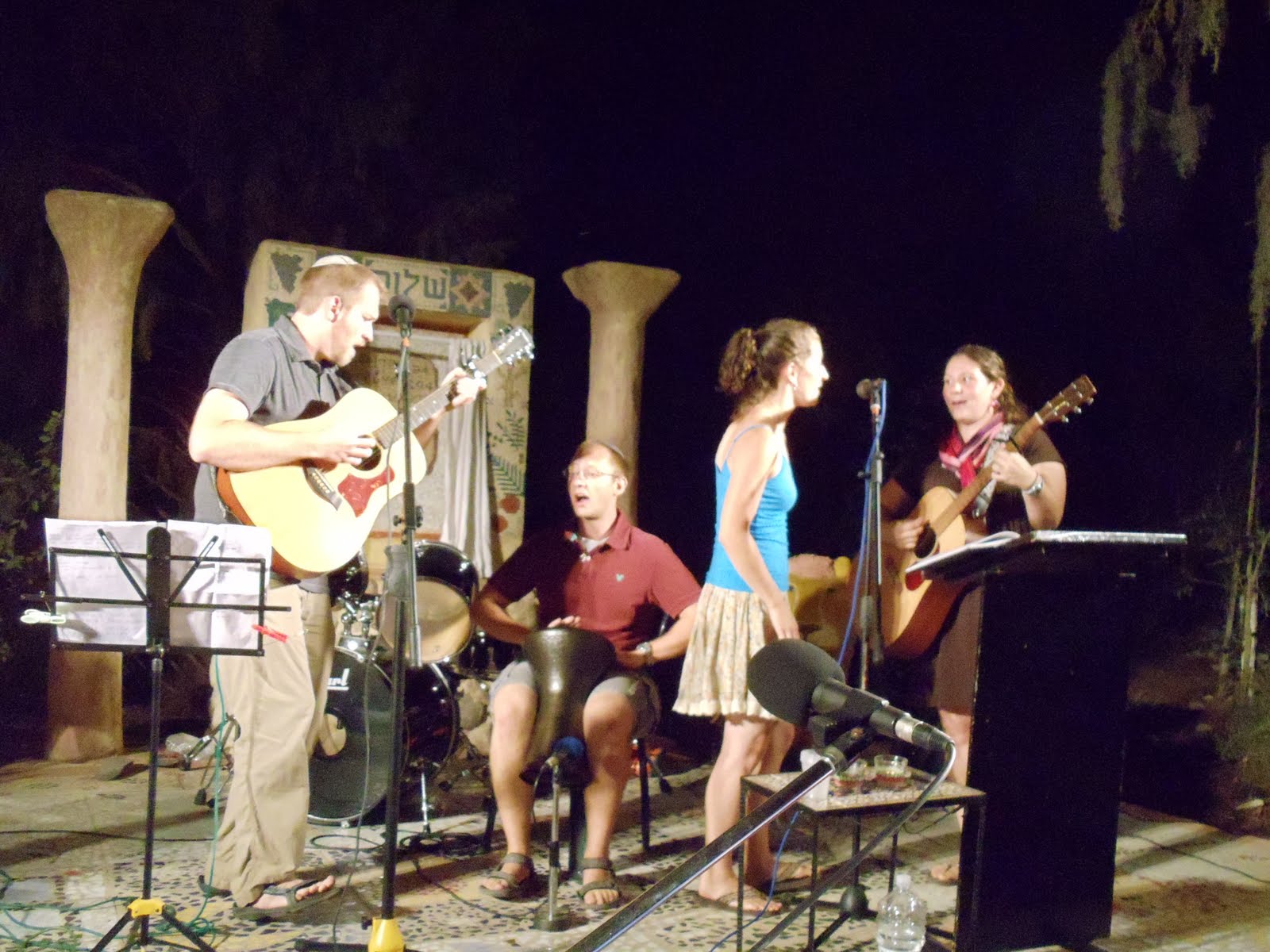 There is a special service in which you conclude reading the Torah, dance around the synagogue in celebration and then start over again. During this service there is a lot of singing and dancing. One of the students here is working with a Kibbutz outside of Jerusalem, Kibbutz Gezer. A group of us went to the Kibbutz to play music for two of the Hakafot -processions. At the last minute, I was able to hop on the bus he had hired and I got to play the hand drum along with the people who were playing guitar and singing. It was a lot of fun!
I had been planning on playing for a Reform Congregation with a few other students the next morning at Har El. We got to take the music on all of the Hafakot and it was a lot of fun that morning too. While they were reading from the Torah though, they used a trope -a system that instructs the reader in musically reading from the Torah- that I had never heard before. I believe it was a Sephardic Trope, which was really cool to hear.
 That night, I went for a walk with Sarah around the Old City. What I had completely forgotten is that in "Orthodox" Communities, they celebrate Simchat Torah during the day and again after the sun goes down. Simchat Torah is a full Holy Day and therefore many people refrain from any work. Part of the prohibitions for a Holy Day are that you cannot use electricity. In order to make another celebration with much more music, they celebrate again when the sun goes down. It was really cool to see and hear this celebration while we were walking in the Old City.
Now it's back to school and homework since it is after the holidays.
Saturday, October 2, 2010
Baby 2-Cheese Bareakas with Zatar

I found a basic recipe at the All Recipes website and as you have probably guessed, I changed it up a little. Basically, these are little appetizer type pastries that can be filled with just about anything. They are going to go really well with my salad and hard-boiled egg in the morning.
Ingredients
1 cup mozzarella cheese, shreaded
1 cup yellow cheese, shreaded
1/4 cup onion, chopped
1 tsp garlic powder
1 tsp black pepper
2 tsp parsley, dried
zatar
2 eggs
2 tbsp water
pastry crust - room temperature
flour
Instructions
30 minutes of prep time
23 - 30 minutes of cooking time
First mix together 1 egg, all of your cheeses, garlic powder, onion, black pepper, and parsley.
Put the bowl of this aside.
Crack the 2nd egg and mix it with your water in a small bowl.
Set this aside.
Turn your oven on to 175 celsius or 350 fahrenheit.
Lightly flour the counter top and your cooking sheets.
Roll out your pastry crust on the floured surface and cut it into 1.5in x 1.5in squares (The size doesn't really matter that much).
Put about 1 tbsp of your cheese mixture onto each square/rectangle of pastry crust.
Paint the edges with the water/egg mixture.
Fold the pastry over into whatever shape you like. I tried triangles, envelopes and rolls. This is entirely up to you. Just make sure that the edges that touch each other have some egg on them so it stays together.
Place them on your baking sheet.
Paint the tops with egg/water mixture.
Sprinkle as much/little Zatar as you want on the top.
Put in your 175 C (350 F) oven for 23 - 30 minutes.
Check on them and take them out wen they start to turn golden brown and have puffed up.
They are best when served warm.
Like anything, I'm glad I made this for myself before I tried to make them for anyone else. They didn't turn out to be the best thing I've ever made. They are pretty good, but I need to play with the cheese and find a blend that I like. I also need to find the right size to cut the squares into. According to the recipe, there were supposed to be only 12, and I ended up with 19. I think there was supposed to be more cheese in each one.
Not the best I've had, but also not the worst thing in the world. Play with the different blends of cheese, you can get some interesting combinations and I'm sure you can add some other things to bake into the pastry. I'll play again later and let you know how it turns out!
B'tayavon!
Friday, October 1, 2010
You Can't Eat Here
I have been wearing a kippah almost all of the time. Apparently that makes a strong statement about who I am and what I do to practice my Judaism. I was going out to dinner with a friend a few days ago and she wanted to go to a pizza place. But as we walk in the owner of the restaurant started telling me that I can't eat at his restaurant.
When I gave him a confused look, he told me that they weren't certified as kosher and I shouldn't eat there. He looked even more confused when I told him it was okay, and I took off my kippah. There are two things at play here; the polarized view of what religion is in Israel, and the owner's respect and concern for me potentially breaking kashrut.
I was very appreciative of his concern for me. It is nice to know that people here understand the symbols and are partially looking out for you. This is just one example of how nice Israelis actually are, despite their rough exterior. What concerned me though, was the stark polarization of religion in Israel.
I'm sure this will come up again and again. In Israel, most people consider themselves either "Orthodox", or secular. To many people, there is no in between. There is no way that someone who wears a kippah could eat in a non-certified restaurant. If I have a kippah on, I should not do anything to break the traditional observance of Shabbat. It makes me stop and think a lot more about what these religious symbols mean here.
It also makes me think about the situation of pluralism in Israel. I was recently reading Rabbi Kravitz's sermon that he gave on Rosh HaShanah this year and here is the link to his sermon that I posted on my blog.
It seems to me that in Israel, there is a lack of understanding of the scope of religious observances that are possible in other places. I heard a friend say that Reform Judaism is something that will not catch on in Israel because there doesn't seem to be a need for it. Being a secular Israeli is pretty close to being in the Reform Movement. While I do think that Reform Judaism (and other manifestations of Judaism) do have an uphill battle in this country, there is a place for it here.
kashrut - Kashrut is the system of dietary laws that govern the way that Jews are commanded to eat.
When I gave him a confused look, he told me that they weren't certified as kosher and I shouldn't eat there. He looked even more confused when I told him it was okay, and I took off my kippah. There are two things at play here; the polarized view of what religion is in Israel, and the owner's respect and concern for me potentially breaking kashrut.
I was very appreciative of his concern for me. It is nice to know that people here understand the symbols and are partially looking out for you. This is just one example of how nice Israelis actually are, despite their rough exterior. What concerned me though, was the stark polarization of religion in Israel.
I'm sure this will come up again and again. In Israel, most people consider themselves either "Orthodox", or secular. To many people, there is no in between. There is no way that someone who wears a kippah could eat in a non-certified restaurant. If I have a kippah on, I should not do anything to break the traditional observance of Shabbat. It makes me stop and think a lot more about what these religious symbols mean here.
It also makes me think about the situation of pluralism in Israel. I was recently reading Rabbi Kravitz's sermon that he gave on Rosh HaShanah this year and here is the link to his sermon that I posted on my blog.
It seems to me that in Israel, there is a lack of understanding of the scope of religious observances that are possible in other places. I heard a friend say that Reform Judaism is something that will not catch on in Israel because there doesn't seem to be a need for it. Being a secular Israeli is pretty close to being in the Reform Movement. While I do think that Reform Judaism (and other manifestations of Judaism) do have an uphill battle in this country, there is a place for it here.
kashrut - Kashrut is the system of dietary laws that govern the way that Jews are commanded to eat.
Rabbi Kravitz's Rosh HaShanah Sermon, 5771
The following is NOT my work in any way shape or form. It is the sermon that Rabbi Kravitz delivered at Adath Jeshurun in Minnetonka, MN on Rosh HaShanah this year. I found it fascinating and it connects to some of the things I have been thinking and talking about here in Israel.
Rosh Hashana I 5771 Sept 9, 2010
Support Religious Pluralism in Israel
This is a ketubah- a Jewish marriage contract. Ketubot come in
different forms, some quite simple and others beautifully illuminated. The
ketubah confirms the commitment that two Jews make when they marry in a
Jewish ceremony. I ask for a show of hands, how many of you have a copy
of your parent’s ketubah? Clearly, if your parents are not Jewish or they
didn’t have a Jewish wedding ceremony you don’t have one. I have no idea
what happened to my parent’s ketubah.
How many of you have a ketubah for your grandparents? I don’t.
How about your great-grandparents? Unlikely.
A young man in our congregation, let’s call him “Ari”, contacted me
this year for assistance as he plans to marry a Jewish woman in Israel and
was asked to provide these documents, and others, to prove he is a Jew. You
cannot imagine the hassles he has had to go through. Thankfully, it looks
like he will be successful establishing his Jewish ancestry. However, if a
non-Orthodox conversion had been found on his mother side of the family,
the door would have quickly closed on his plans.
Let me assure you that “Ari” found the experience infuriating. You
should also know that what he experienced is now the norm in Israel.
Orthodox rabbis on the payroll of Israel’s government are charged with
determining whether a person who claims to be Jewish satisfies the
standards of the Chief Rabbinate. Since the creation of the State of Israel the
Chief Rabbinate has had sole authority overseeing Jewish marriage and
divorce. They have not, in the past, had authority to rule on “who is a Jew”
for the sake of citizenship under the Law of Return, which allows anyone
with at least one Jewish grandparent, or converted by a rabbi of any of the
major movements, to immediately become a citizen of Israel. That would
have changed this year thanks to Knesset member David Rotem, whose bill
you likely heard about this summer. But I am getting ahead of myself. Let’s
first focus on the issue of how any of us who is born Jewish would prove
that in Israel today.
In March, 2008 Gershom Gorenberg, a respected Israeli journalist
wrote an article for the New York Times Magazine called, “How Do You
Prove You’re a Jew?” in which he warned of this development that our
congregant “Ari” experienced first hand. Gorenberg wrote about a young
Israeli woman named Sharon who went with her fiancé to the Tel Aviv
Rabbinate to register to marry. The Orthodox rabbi staffing the city office
that registers weddings asked Sharon to prove that she was Jewish by
bringing a copy of her parent’s ketubah, the document that many of us here
do not even have.
It so happens that Sharon’s family is from Minneapolis. Her mother,
Suzie, now 68, grew up here, made aliyah and lives on kibbutz. Suzie’s
background is similar to that of many of our members. Her grandparents
were Jews who came from Russia at the turn of the 20th century. Suzie’s
parent’s Belle and Julius Goldstein married in a Conservative ceremony and
were members of Beth El Congregation going back to when it was on the
North Side. After graduating from the U of MN, Suzie went to Israel where
she met a British non-Jew. They married in a civil ceremony in England, as
there is no civil marriage available in Israel. Since there was no Jewish
marriage, there was no ketubah. According to halacha, Jewish law, their
daughter Sharon was indisputably Jewish, but the office of the Chief
Rabbinate put the young woman through the wringer until they agreed.
As “Ari,” the young man from our congregation, found out this
process is not unusual in Israel, As I said it has become the norm. As
Gorenberg explained in his NY Times article, “the state’s Chief Rabbinate
and its branches in each Israeli city have adopted an institutional attitude of
skepticism toward the Jewish identity of those who enter its doors…The
Israeli government seeks the political and financial support of American
Jewry. It welcomes American Jewish immigrants. Yet the rabbinate, one arm
of the state, increasingly treats American Jews as doubtful cases: not Jewish
until proved so.”
So I ask how many of us could prove to an Orthodox rabbi in Israel
that we are Jews? Let me share another troubling story that does not have a
happy ending. In April, a story appeared in the Israeli newspaper Yediot
Achronot (4/30/10) about a young woman named Jessica Fishman who made
aliyah seven years ago and joined Israel’s army. Jessica’s Dad Les served as
President of Beth Jacob Congregation in Mendota Heights. Before Jessica
was born, her mom converted to Judaism with a Reform rabbi, with mikveh,
in St. Louis and then moved to the Twin Cities. Here the family lived a
traditional Jewish life observing Shabbat, keeping a kosher home, and
sending their kids to Herzl Camp. Jessica traveled to Israel as a teenager
with USY and spent her junior year at Hebrew University. After college she
made aliyah. Hers is an impressive example of the kind of Jewish
commitments that can be shaped by the institutions of our community.
After two years of army service she settled in Herzliya where she met
an Israeli guy. When they decided to get married they went to the local rabbi
who began to investigate. When he learned that her mother converted with a
Reform rabbi he explored no further. Eventually the couple split up and
Jessica, who was so committed to living in Israel, left the country. When
interviewed in April, she said she had no intention of returning. How tragic
when someone who was so committed to Israel is pushed away!
These are the kinds of travesties being perpetrated by Israel’s Chief
Rabbinate. Let me be clear, I would not presume to suggest that Orthodox
rabbis do not have the right to determine who they believe fulfills their
requirements for conversion, or the right to decide for themselves “who is a
Jew.” They absolutely have that right. The outrage is when a Chief
Rabbinate is empowered to act on behalf of the State in making those
decisions.
This was why so many of us were roused to action this summer when
Knesset Member David Rotem, representing the Yisrael Beiteinu party made
up largely of Jews from the Former Soviet Union, proposed to change
Israel’s law. He would have expanded the authority of the Chief Rabbinate
to rule not only over the personal issues of marriage and divorce in Israel,
which is bad enough, but for the first time empower them to make decisions
over who is eligible to be granted Israeli citizenship. Rotem’s stated
intention was to address the needs of the hundreds of thousands of Jews
from the Former Soviet Union of questionable ancestry, who wish to be fully
accepted in Israel. In order to get the support of the powerful minority
religious parties, the proposed bill would have undercut the conversions of
non-Orthodox rabbis in the Diaspora, and even of Orthodox rabbis whom
the Chief Rabbinate does not consider sufficiently Charedi ultra-Orthodox.
Thankfully the outrage expressed by leaders of the Conservative and Reform
Movements, with the crucial support of Natan Sharansky, who heads the
Jewish Agency and Jerry Silverman, the President of the North American
Jewish Federations, and others, led to the tabling of Rotem’s bill.
Prime Minister Benjamin Netanyahu received more than 60,000
messages expressing concern. Nearly 27,000 of those were emails sent
through the link on the Masorti Movement’s website. For now the Rotem
bill is tabled, but not dead. Negotiations are supposed to take place before
the Knesset reconvenes in October.
In October, with God’s help, I am going to Israel on a mission
arranged by the Masorti Movement, our Conservative movement in Israel. I
will be joined by recent past President of our congregation Heidi Schneider,
to send a clear message from our community that we find it unacceptable for
Charedi rabbis to have authority over the State of Israel, let alone over the
Jewish world. We will be speaking up for our young congregant “Ari.” We
will be speaking up for Sharon and for Jessica and for every person in this
room who would struggle to prove that they are Jewish to the satisfaction of
the Chief Rabbinate. Look around the room. How many of you would have
trouble proving to them that you or your children or your loved ones, or your
friends are Jewish? Heidi and I are going to Israel on this mission for each of
you and for all of us who care about you.
There are many things to worry about for Israel- the real threats posed
by Iran, by Hezbollah in Lebanon and by Hamas in Gaza. We worry about
the growing efforts to de-legitimize the very existence of a Jewish State,
efforts we must adamantly oppose. I am grateful that a renewed peace
initiative between Israel and the Palestinians was launched last week in
Washington and we pray for its success, though based on painful past
experiences we worry about that also. As a community we have stood up on
behalf of Israel time and time again and will continue to do so. It is
disheartening, however, to see our support taken for granted and our
legitimacy as Jews called in to question. It is unacceptable for Israeli
politicians to succumb to the blackmail of ultra-religious parties seeking
exclusive control in defining “Who is a Jew.”
I would be surprised if every one here is not outraged by the stories I
have told. What I find astonishing, however, is the incredibly lackluster
response of our community to these issues. Though, thankfully, many of our
members are active as advocates on behalf of Israel, through an array of
organizations, when it comes to the issue of religious pluralism in Israel they
are almost silent. Minuscule portions of our people’s contributions to Israel
are directed towards addressing these issues. It seems that the only time that
the issue of religious pluralism in Israel gets serious attention from most of
us is when there is dramatic news, such as the recent attempt to pass the
Rotem Bill.
You need to know that Israel is undergoing dramatic changes before
our very eyes. Israeli journalist Isi Leibler, in an article in the Jerusalem Post
(4-2-10), describes the rapid growth of the Charedi Ultra-Orthodox
population in Israel. According to Leibler, in the 1980s Charedim comprised
4 percent of Israel’s population, today they represent 10%, or about 700,000,
averaging 8.8 children per family. At that rate, in less than two decades,
Charedim could amount to 20% of Israel’s Jewish population.
Consider another sobering statistic, currently, 25% of all Jewish
primary school-age children are enrolled in Charedi institutions – double the
proportion of 10 years ago. Many of these do not celebrate Israel’s
Independence Day, do not recognize the Israeli flag, do not permit the
singing of “Hatikva” and discourage their students from serving in the Israel
Defense Forces. If this trend is maintained, 20 years from now, 40% of
Jewish children will attend Charedi schools. Assuming these trends
continue, what do you think Israel will look like twenty years from now?
This past March we heard a vivid description from Rabbi Gil
Nativ, the rabbi of our sister Masorti Congregation in Omer, Magen
Avraham, of the increasing polarization taking place in Israel. He described
how every year before Simchat Torah he goes out to buy flags for 'Hakafot,'
the circling we do with the Torahs to celebrate the completion of the reading
cycle. Two decades ago he could easily find flags with a picture of boys and
girls dancing around a Torah scroll.
These flags have almost disappeared from the market. Now there are only
boys and men dancing on these paper flags! (Also note the absence of the
Israeli flag!)
He observed that the manufacturers are careful not to upset the 'religiously
correct.'
This is just one of many examples of the impact of Charedi Ultra-
Orthodox Judaism on Israeli life. There are intense debates going on about
Chaerdi demands in Jerusalem that women be required to sit in the back of
public buses and that the planned light rail have some cars designated for
men only. This week the Jerusalem police recommended the prosecution of
Anat Hoffman, a rabbi arrested this summer for carrying a Sefer Torah
through the Kotel plaza on her way to services at the less conspicuous
southern section of the wall, established by Israel’s Supreme Court as an
alternate place for non-Orthodox minyanim. If successfully prosecuted, she
could be jailed for three years. Is that the kind of State of Israel that we have
worked so hard to create?
I wish no ill to the Charedi community. Let them be well! What is
unacceptable is that the bill for their growth is being paid for by massive
funding from Israel’s government! At present, over $400 million are
allocated to Orthodox religious services- hiring 3000 rabbis, providing local
ritual facilities and ritual items, with no more than $100k allocated to
comparable services for Masorti or Reform communities.
I believe it is no exaggeration to say that establishing proper
separation between religion and state is critical to Israel’s survival; certainly
to its survival as a Jewish and democratic state. It is a given to us in America
that no one single religious sector should be able to control the public
square. We are blessed that this concept operates in the Jewish world here at
our Federations, where Jews of different streams and understandings sit at
the table together to maintain our communal structures. American Jewry,
following the Federation model and American democracy has much to teach
Israel.
As I said earlier, the national leadership of the Federation played a
crucial role in tabling the passage of the Rotem Bill helping to convince
Israeli legislators that its passage would create a serious fissure between
Israel and Diaspora Jewry, 85% of whom are not Orthodox. At the core of
the mission of our Federation is a commitment to religious pluralism,
permitting everyone to participate in the life of the community. We need
every member of this congregation to continue to give generously to the
Federation, which greatly needs our support to maintain our community and
care for Jews around the world and in Israel. We also need to send an
unmistakable message through our Federation that the issue of religious
pluralism in Israel is high on the list of our priorities.
In recognition of the importance of supporting religious pluralism, our
Minneapolis Federation, despite severe budgetary strains, agreed to offer a
$10k matching grant for funds raised this year for Israel’s Conservative
movement known as Masorti. Federation is offering the same match for
funds raised for Artza, Israel’s Reform movement. I ask for your help in
meeting that challenge, for which we are grateful, and hope that this match
will grow even larger in the future. Please take a look at the handout you
received today, which gives more information about the work of our Masorti
movement in Israel and about our concerns regarding the Rotem Bill. Israel
is desperately in need of our Masorti movement, which teaches a modern
and sensible form of Judaism and plays a crucial role bridging between
Israel’s religious and secular extremes. As the letter makes clear, significant
inroads have been made in providing that middle ground, even while at a
severe disadvantage for funding.
As we look to the future there is much to be worried about for Israel.
The external threats are great. The internal problems of Israel are no less so.
I ask that today we hear in the sound of the shofar a call to wake up as a
community and stop ignoring this issue of religious pluralism. If we are
indifferent to the developments I have described, we may wake up one day
and find that it is our child who is told they are not Jewish and I fear that our
children and grandchildren like Jessica Fishman will simply walk away from
the place that our people worked so hard to establish. If that occurs we will
have ourselves to blame because of our indifference. The failure to get our
people to fully embrace the cause of religious pluralism and to press for
greater separation between religious and state in Israel will be cataclysmic
for the Jewish people and for the future of the State of Israel as we know and
love it.
At the end of Yom Kippur, at the conclusion of the neilah service we
will sound the shofar and recite the words, “This coming year let us be in
Jerusalem L’shana Habaah Beyirushalayim.” I have painted a troubling
picture of what is happening to Israel. I have done so because I truly believe
that it is not too late for action. It is still possible for us to work on behalf of
a vision for the State of Israel that will welcome Jews of different
approaches and views to the table. The day is short and there is much to be
done... Hayom katzar, v’hamelacha merubah…but as the rabbis teach in
Pirkei Avot (2:20-21), “You are not obligated to complete the task but
neither are you free to neglect it Lo alecha hamelacha lig-mor, Vlo atah ben
chorine lee-ba-tel mi-mena.”
Let us join together in the work of building up our Masorti movement
in Israel, and in working for an Israel not dominated by a single
fundamentalist religious view. Let us join together so that Israel will realize
the visions of the founders of the State as a homeland for all Jews. “Next
year in a rebuilt Jerusalem Lshana habaah beyerushalayim habenuyah.”
Rabbi Harold J. Kravitz
Adath Jeshurun Congregation
Minnetonka, MN
Rosh Hashana I 5771 Sept 9, 2010
Support Religious Pluralism in Israel
This is a ketubah- a Jewish marriage contract. Ketubot come in
different forms, some quite simple and others beautifully illuminated. The
ketubah confirms the commitment that two Jews make when they marry in a
Jewish ceremony. I ask for a show of hands, how many of you have a copy
of your parent’s ketubah? Clearly, if your parents are not Jewish or they
didn’t have a Jewish wedding ceremony you don’t have one. I have no idea
what happened to my parent’s ketubah.
How many of you have a ketubah for your grandparents? I don’t.
How about your great-grandparents? Unlikely.
A young man in our congregation, let’s call him “Ari”, contacted me
this year for assistance as he plans to marry a Jewish woman in Israel and
was asked to provide these documents, and others, to prove he is a Jew. You
cannot imagine the hassles he has had to go through. Thankfully, it looks
like he will be successful establishing his Jewish ancestry. However, if a
non-Orthodox conversion had been found on his mother side of the family,
the door would have quickly closed on his plans.
Let me assure you that “Ari” found the experience infuriating. You
should also know that what he experienced is now the norm in Israel.
Orthodox rabbis on the payroll of Israel’s government are charged with
determining whether a person who claims to be Jewish satisfies the
standards of the Chief Rabbinate. Since the creation of the State of Israel the
Chief Rabbinate has had sole authority overseeing Jewish marriage and
divorce. They have not, in the past, had authority to rule on “who is a Jew”
for the sake of citizenship under the Law of Return, which allows anyone
with at least one Jewish grandparent, or converted by a rabbi of any of the
major movements, to immediately become a citizen of Israel. That would
have changed this year thanks to Knesset member David Rotem, whose bill
you likely heard about this summer. But I am getting ahead of myself. Let’s
first focus on the issue of how any of us who is born Jewish would prove
that in Israel today.
In March, 2008 Gershom Gorenberg, a respected Israeli journalist
wrote an article for the New York Times Magazine called, “How Do You
Prove You’re a Jew?” in which he warned of this development that our
congregant “Ari” experienced first hand. Gorenberg wrote about a young
Israeli woman named Sharon who went with her fiancé to the Tel Aviv
Rabbinate to register to marry. The Orthodox rabbi staffing the city office
that registers weddings asked Sharon to prove that she was Jewish by
bringing a copy of her parent’s ketubah, the document that many of us here
do not even have.
It so happens that Sharon’s family is from Minneapolis. Her mother,
Suzie, now 68, grew up here, made aliyah and lives on kibbutz. Suzie’s
background is similar to that of many of our members. Her grandparents
were Jews who came from Russia at the turn of the 20th century. Suzie’s
parent’s Belle and Julius Goldstein married in a Conservative ceremony and
were members of Beth El Congregation going back to when it was on the
North Side. After graduating from the U of MN, Suzie went to Israel where
she met a British non-Jew. They married in a civil ceremony in England, as
there is no civil marriage available in Israel. Since there was no Jewish
marriage, there was no ketubah. According to halacha, Jewish law, their
daughter Sharon was indisputably Jewish, but the office of the Chief
Rabbinate put the young woman through the wringer until they agreed.
As “Ari,” the young man from our congregation, found out this
process is not unusual in Israel, As I said it has become the norm. As
Gorenberg explained in his NY Times article, “the state’s Chief Rabbinate
and its branches in each Israeli city have adopted an institutional attitude of
skepticism toward the Jewish identity of those who enter its doors…The
Israeli government seeks the political and financial support of American
Jewry. It welcomes American Jewish immigrants. Yet the rabbinate, one arm
of the state, increasingly treats American Jews as doubtful cases: not Jewish
until proved so.”
So I ask how many of us could prove to an Orthodox rabbi in Israel
that we are Jews? Let me share another troubling story that does not have a
happy ending. In April, a story appeared in the Israeli newspaper Yediot
Achronot (4/30/10) about a young woman named Jessica Fishman who made
aliyah seven years ago and joined Israel’s army. Jessica’s Dad Les served as
President of Beth Jacob Congregation in Mendota Heights. Before Jessica
was born, her mom converted to Judaism with a Reform rabbi, with mikveh,
in St. Louis and then moved to the Twin Cities. Here the family lived a
traditional Jewish life observing Shabbat, keeping a kosher home, and
sending their kids to Herzl Camp. Jessica traveled to Israel as a teenager
with USY and spent her junior year at Hebrew University. After college she
made aliyah. Hers is an impressive example of the kind of Jewish
commitments that can be shaped by the institutions of our community.
After two years of army service she settled in Herzliya where she met
an Israeli guy. When they decided to get married they went to the local rabbi
who began to investigate. When he learned that her mother converted with a
Reform rabbi he explored no further. Eventually the couple split up and
Jessica, who was so committed to living in Israel, left the country. When
interviewed in April, she said she had no intention of returning. How tragic
when someone who was so committed to Israel is pushed away!
These are the kinds of travesties being perpetrated by Israel’s Chief
Rabbinate. Let me be clear, I would not presume to suggest that Orthodox
rabbis do not have the right to determine who they believe fulfills their
requirements for conversion, or the right to decide for themselves “who is a
Jew.” They absolutely have that right. The outrage is when a Chief
Rabbinate is empowered to act on behalf of the State in making those
decisions.
This was why so many of us were roused to action this summer when
Knesset Member David Rotem, representing the Yisrael Beiteinu party made
up largely of Jews from the Former Soviet Union, proposed to change
Israel’s law. He would have expanded the authority of the Chief Rabbinate
to rule not only over the personal issues of marriage and divorce in Israel,
which is bad enough, but for the first time empower them to make decisions
over who is eligible to be granted Israeli citizenship. Rotem’s stated
intention was to address the needs of the hundreds of thousands of Jews
from the Former Soviet Union of questionable ancestry, who wish to be fully
accepted in Israel. In order to get the support of the powerful minority
religious parties, the proposed bill would have undercut the conversions of
non-Orthodox rabbis in the Diaspora, and even of Orthodox rabbis whom
the Chief Rabbinate does not consider sufficiently Charedi ultra-Orthodox.
Thankfully the outrage expressed by leaders of the Conservative and Reform
Movements, with the crucial support of Natan Sharansky, who heads the
Jewish Agency and Jerry Silverman, the President of the North American
Jewish Federations, and others, led to the tabling of Rotem’s bill.
Prime Minister Benjamin Netanyahu received more than 60,000
messages expressing concern. Nearly 27,000 of those were emails sent
through the link on the Masorti Movement’s website. For now the Rotem
bill is tabled, but not dead. Negotiations are supposed to take place before
the Knesset reconvenes in October.
In October, with God’s help, I am going to Israel on a mission
arranged by the Masorti Movement, our Conservative movement in Israel. I
will be joined by recent past President of our congregation Heidi Schneider,
to send a clear message from our community that we find it unacceptable for
Charedi rabbis to have authority over the State of Israel, let alone over the
Jewish world. We will be speaking up for our young congregant “Ari.” We
will be speaking up for Sharon and for Jessica and for every person in this
room who would struggle to prove that they are Jewish to the satisfaction of
the Chief Rabbinate. Look around the room. How many of you would have
trouble proving to them that you or your children or your loved ones, or your
friends are Jewish? Heidi and I are going to Israel on this mission for each of
you and for all of us who care about you.
There are many things to worry about for Israel- the real threats posed
by Iran, by Hezbollah in Lebanon and by Hamas in Gaza. We worry about
the growing efforts to de-legitimize the very existence of a Jewish State,
efforts we must adamantly oppose. I am grateful that a renewed peace
initiative between Israel and the Palestinians was launched last week in
Washington and we pray for its success, though based on painful past
experiences we worry about that also. As a community we have stood up on
behalf of Israel time and time again and will continue to do so. It is
disheartening, however, to see our support taken for granted and our
legitimacy as Jews called in to question. It is unacceptable for Israeli
politicians to succumb to the blackmail of ultra-religious parties seeking
exclusive control in defining “Who is a Jew.”
I would be surprised if every one here is not outraged by the stories I
have told. What I find astonishing, however, is the incredibly lackluster
response of our community to these issues. Though, thankfully, many of our
members are active as advocates on behalf of Israel, through an array of
organizations, when it comes to the issue of religious pluralism in Israel they
are almost silent. Minuscule portions of our people’s contributions to Israel
are directed towards addressing these issues. It seems that the only time that
the issue of religious pluralism in Israel gets serious attention from most of
us is when there is dramatic news, such as the recent attempt to pass the
Rotem Bill.
You need to know that Israel is undergoing dramatic changes before
our very eyes. Israeli journalist Isi Leibler, in an article in the Jerusalem Post
(4-2-10), describes the rapid growth of the Charedi Ultra-Orthodox
population in Israel. According to Leibler, in the 1980s Charedim comprised
4 percent of Israel’s population, today they represent 10%, or about 700,000,
averaging 8.8 children per family. At that rate, in less than two decades,
Charedim could amount to 20% of Israel’s Jewish population.
Consider another sobering statistic, currently, 25% of all Jewish
primary school-age children are enrolled in Charedi institutions – double the
proportion of 10 years ago. Many of these do not celebrate Israel’s
Independence Day, do not recognize the Israeli flag, do not permit the
singing of “Hatikva” and discourage their students from serving in the Israel
Defense Forces. If this trend is maintained, 20 years from now, 40% of
Jewish children will attend Charedi schools. Assuming these trends
continue, what do you think Israel will look like twenty years from now?
This past March we heard a vivid description from Rabbi Gil
Nativ, the rabbi of our sister Masorti Congregation in Omer, Magen
Avraham, of the increasing polarization taking place in Israel. He described
how every year before Simchat Torah he goes out to buy flags for 'Hakafot,'
the circling we do with the Torahs to celebrate the completion of the reading
cycle. Two decades ago he could easily find flags with a picture of boys and
girls dancing around a Torah scroll.
These flags have almost disappeared from the market. Now there are only
boys and men dancing on these paper flags! (Also note the absence of the
Israeli flag!)
He observed that the manufacturers are careful not to upset the 'religiously
correct.'
This is just one of many examples of the impact of Charedi Ultra-
Orthodox Judaism on Israeli life. There are intense debates going on about
Chaerdi demands in Jerusalem that women be required to sit in the back of
public buses and that the planned light rail have some cars designated for
men only. This week the Jerusalem police recommended the prosecution of
Anat Hoffman, a rabbi arrested this summer for carrying a Sefer Torah
through the Kotel plaza on her way to services at the less conspicuous
southern section of the wall, established by Israel’s Supreme Court as an
alternate place for non-Orthodox minyanim. If successfully prosecuted, she
could be jailed for three years. Is that the kind of State of Israel that we have
worked so hard to create?
I wish no ill to the Charedi community. Let them be well! What is
unacceptable is that the bill for their growth is being paid for by massive
funding from Israel’s government! At present, over $400 million are
allocated to Orthodox religious services- hiring 3000 rabbis, providing local
ritual facilities and ritual items, with no more than $100k allocated to
comparable services for Masorti or Reform communities.
I believe it is no exaggeration to say that establishing proper
separation between religion and state is critical to Israel’s survival; certainly
to its survival as a Jewish and democratic state. It is a given to us in America
that no one single religious sector should be able to control the public
square. We are blessed that this concept operates in the Jewish world here at
our Federations, where Jews of different streams and understandings sit at
the table together to maintain our communal structures. American Jewry,
following the Federation model and American democracy has much to teach
Israel.
As I said earlier, the national leadership of the Federation played a
crucial role in tabling the passage of the Rotem Bill helping to convince
Israeli legislators that its passage would create a serious fissure between
Israel and Diaspora Jewry, 85% of whom are not Orthodox. At the core of
the mission of our Federation is a commitment to religious pluralism,
permitting everyone to participate in the life of the community. We need
every member of this congregation to continue to give generously to the
Federation, which greatly needs our support to maintain our community and
care for Jews around the world and in Israel. We also need to send an
unmistakable message through our Federation that the issue of religious
pluralism in Israel is high on the list of our priorities.
In recognition of the importance of supporting religious pluralism, our
Minneapolis Federation, despite severe budgetary strains, agreed to offer a
$10k matching grant for funds raised this year for Israel’s Conservative
movement known as Masorti. Federation is offering the same match for
funds raised for Artza, Israel’s Reform movement. I ask for your help in
meeting that challenge, for which we are grateful, and hope that this match
will grow even larger in the future. Please take a look at the handout you
received today, which gives more information about the work of our Masorti
movement in Israel and about our concerns regarding the Rotem Bill. Israel
is desperately in need of our Masorti movement, which teaches a modern
and sensible form of Judaism and plays a crucial role bridging between
Israel’s religious and secular extremes. As the letter makes clear, significant
inroads have been made in providing that middle ground, even while at a
severe disadvantage for funding.
As we look to the future there is much to be worried about for Israel.
The external threats are great. The internal problems of Israel are no less so.
I ask that today we hear in the sound of the shofar a call to wake up as a
community and stop ignoring this issue of religious pluralism. If we are
indifferent to the developments I have described, we may wake up one day
and find that it is our child who is told they are not Jewish and I fear that our
children and grandchildren like Jessica Fishman will simply walk away from
the place that our people worked so hard to establish. If that occurs we will
have ourselves to blame because of our indifference. The failure to get our
people to fully embrace the cause of religious pluralism and to press for
greater separation between religious and state in Israel will be cataclysmic
for the Jewish people and for the future of the State of Israel as we know and
love it.
At the end of Yom Kippur, at the conclusion of the neilah service we
will sound the shofar and recite the words, “This coming year let us be in
Jerusalem L’shana Habaah Beyirushalayim.” I have painted a troubling
picture of what is happening to Israel. I have done so because I truly believe
that it is not too late for action. It is still possible for us to work on behalf of
a vision for the State of Israel that will welcome Jews of different
approaches and views to the table. The day is short and there is much to be
done... Hayom katzar, v’hamelacha merubah…but as the rabbis teach in
Pirkei Avot (2:20-21), “You are not obligated to complete the task but
neither are you free to neglect it Lo alecha hamelacha lig-mor, Vlo atah ben
chorine lee-ba-tel mi-mena.”
Let us join together in the work of building up our Masorti movement
in Israel, and in working for an Israel not dominated by a single
fundamentalist religious view. Let us join together so that Israel will realize
the visions of the founders of the State as a homeland for all Jews. “Next
year in a rebuilt Jerusalem Lshana habaah beyerushalayim habenuyah.”
Rabbi Harold J. Kravitz
Adath Jeshurun Congregation
Minnetonka, MN
Subscribe to:
Posts (Atom)